


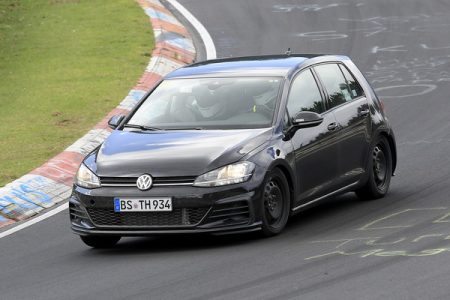
Development for the Golf has been underway for more than two years now, with key aspects of the car already described by high-level Volkswagen sources as having committed project status.
Despite the upheaval brought to its operations by the diesel emissions manipulation scandal and subsequent legal complications in key world markets, Volkswagen has confirmed that it is holding firm to the original launch schedule for the new model. That means volume-selling versions of the new Golf are planned to reach showrooms during the final quarter of 2019.
VW has laid the foundation for both cylinder shutdown and engine-off coasting functions in the turbocharged 1.5 TSI Bluemotion petrol version of the updated current Golf through the adoption of a twin 12V electrical system. Now VW has confirmed that the company is set to take the fuel-saving technology one step further.
It is planning a more contemporary, 48V system that will enable the next Golf to be more comprehensively networked for more intuitive operation and greater fuel savings, particularly with petrol versions of the car.
Autonomous driving will be a key feature of Volkswagen’s best-seller in its eighth generation, as the brand will shoehorn even more advanced autonomous technology into the new model, as well as ensuring it is the most connected model in the brand’s history, ahead of the all-electric ID hatchback in late 2019.
The current Golf benefits from Volkswagen’s semi-autonomous Traffic Jam Assist system, which controls the steering, acceleration and braking of the car under 60 km/h, so it’s certain that the eighth-generation model will take a leap in advancement over this. Elsewhere in the Volkswagen Group, the Audi A8 is the first to achieve level 3 autonomy where permitted.
With VW’s ID electric line-up on the way, the eighth-generation Golf will have a range of petrol, diesel and hybrid powertrains. The adoption of the 48V electrical system indicates that Volkswagen is placing greater emphasis on petrol units than in past generations, with functions such as cylinder shutdown and engine-off coasting set to become standard on many models.
The new or upgraded powertrains will be offered in combination with either a six-speed manual or seven-speed dual-clutch automatic gearbox, depending on their configuration. Alongside front-wheel drive, Volkswagen also plans optional four-wheel drive 4Motion in selected models in a repeat of the previous four generations of its perennial best seller.
On the petrol side, the entry-level models will forgo the existing turbocharged 1.2-litre four-cylinder engine of today’s model for the lighter turbocharged 1.0-litre three-cylinder unit already launched in the latest Golf.
The existing turbocharged 1.5 TSI engine, which made its debut as a replacement for the older 1.4 TSI in the facelift, is set to be upgraded with a particulate filter. This move is aimed at providing lower tailpipe emissions to help achieve the EU’s prescribed 95g/km fleet average CO2 levels by 2020.
It will come as standard, with both the cylinder shutdown and coasting functions to be offered in the newly unveiled seventh-generation Golf TSI BlueMotion Edition, which already has a claimed average CO2 rating of 104g/km.
Diesels will include a yet to be revealed 1.5-litre four-cylinder unit as a replacement for today’s 1.6 TDI. There will also be an updated version of today’s 2.0 TDI in at least three different power outputs. Both diesels will be coupled with a newly developed SCR (selective catalytic reduction) system, which is claimed to contribute to a 10% reduction in CO2 levels compared with today’s diesels.
Secrecy surrounds Volkswagen’s hybrid plans, although supplier sources close to its engineering operations suggest the turbocharged 1.4-litre four-cylinder petrol engine used in today’s Golf GTE could be supplanted by a cheaper, naturally aspirated version of the German car maker’s 1.5-litre petrol unit in a move aimed at reducing production costs.
The next-generation Volkswagen Golf GTI is set to adopt a mild hybrid powertrain that promises to boost performance and refinement while reducing fuel consumption and emissions compared with the recently facelifted current model.
The adoption of an advanced 48V electrical system and integrated starter motor on the new hot hatchback is part of a powertrain overhaul that will be reflected across the whole Mk8 Golf line-up. The changes are also set to make the new model the most powerful series-production Golf GTI yet.
Although the new Golf GTI is still two years away from its introduction, sources close to Volkswagen research and development boss Frank Welsch have revealed that the initial performance targets point to a power output similar to the 261bhp of the limited-edition Golf GTI Clubsport.
Scheduled to go on sale in 2020, the new Golf GTI will retain an internal combustion engine: VW’s familiar turbocharged 2.0-litre petrol unit. However, the introduction of the 48V electric system will allow the four-cylinder engine to receive comprehensive modifications. It’s likely that the exhaust gas turbocharger of today’s model will make way for an electrically operated compressor that offers improved low-end response and a broader plateau of torque for added flexibility.
Additionally, the integrated starter motor will allow VW to provide the front-wheel-drive Golf GTI with a so-called boost function in which an electric motor mounted in the front section of its standard-fit seven-speed dual-clutch automatic gearbox supplements the combustion engine in Performance mode.
The basis for the next Golf is an updated version of the versatile MQB platform used by today’s model. Volkswagen insiders suggest it will use a greater percentage of lightweight metal than the existing structure for a 50kg reduction.




















No comment yet, add your voice below!