


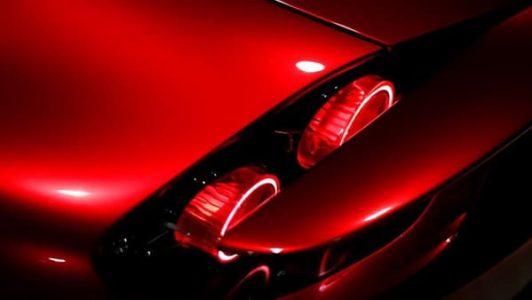

Shapes and colours create first impressions, and no other aspect of a vehicle is so immediately – and intimately – associated with quality as the exterior finish.
At Mazda, Takuminuri, the carmaker’s advanced painting process, is designed to enrich the elegant body surfaces of its Kodo vehicle designs with unique colours like Soul Red Crystal or Polymetal Grey, featured on the 2020 World Car Design of the Year-winning Mazda3.
Takuminuri is a product of decades of experience with materials and techniques. Progressive colour schemes can be traced back to Mazda’s early models. The Mazda-Go Type GA “Green Panel”, a three-wheeled truck launched in 1938, got its name from its green dash – a youthful touch in an otherwise restrained utility vehicle segment.
The company’s first mass-produced passenger car, the Mazda R360, hit the market in 1960 with a choice of refreshing colours including mint green, sky blue and bright red, clearly setting it apart from the predominantly white competition. Despite being an affordable microcar, it was even offered with two-tone finishes. Combinations like the white body with burgundy roof, gave a refined air to the adorable four-seater coupé while also underscoring Mazda’s focus on unconventional designs and driver-oriented engineering, something that continues to this day. The R360 was an immediate hit, capturing almost two-thirds of its segment in Japan in 1960 and fulfilling the dream of car ownership for tens of thousands of people.
Setting colour precedents
As Mazda expanded its model line-up in the 1960s, it offered exclusive metallic finishes on compact and mid-sized models. The Mazda Luce (1966-73), for example, could be ordered in gold or silver – colours associated with luxury and speed – accentuating a sporty, elegant exterior designed by none other than up-and-coming legend Giorgetto Giugiaro. The Luce was one of the first internationally sought-after models from Japan.
The Mazda Cosmo Sport/110S, in contrast, arrived in 1967 in pure white, chosen not only to emphasise the super sportscar’s space-age design, but also because it was Japan’s official FIA motorsport team racing colour. Mazda’s first production car with a rotary engine, the Cosmo Sport/110S would in fact soon prove its capability and dependability on the track, unexpectedly finishing fourth in its initial race, the 1968 Marathon de la Route, a gruelling event also known as the 84 Hours of Nürburgring.
The 1960s saw the early adoption of alkyd resin paint and new drying chambers, allowing Mazda to produce durable finishes while avoiding chalking and the associated loss of surface shine that was a widespread problem at the time. In the 1970s, Mazda was also one of the pioneers of cathodic dip coating (also known as cataphoretic dip painting). The technique uses an electrical charge in the paint to enhance coverage and encourage even distribution for more effective corrosion protection, particularly in body cavities.
A feast for the eyes
A flamboyant era began in 1977 with the first-generation Mazda 323, which blended a European hatchback look with a range of intense colours like Muscat Green, Impulse Blue, Grand Prix Red and Sunbeam Silver Metallic. Brightening up the roads around Europe, the 323 would be one of regions most popular imports.
Speaking of bright, one indisputable highlight of Mazda’s colourful period transpired in 1991, when car no. 55, a green and orange Mazda 787B, took the chequered flag at that year’s 24 Hours of Le Mans. The flashy finish and distinguishing scream of the 710PS four-rotor 26B engine, will forever be associated with the first win at the illustrious event by an Asian manufacturer, and the only one so far by a car without a piston engine. The Mazda MX-5 “Le Mans”, a 2011 limited edition commemorating the 20th anniversary of the race, was clad in the 787B’s distinctive livery. It is also one of the few MX-5 versions with a turbocharger.
When it comes to vivid hues, the MX-5 has introduced many new colours over the past three decades. It has featured a wide range of finishes, from sports-car standards such as Classic Red and British Racing Green, to more conspicuous special edition colours like the Sunracer’s Sunburst Yellow (1995), Spirited Green (Karai, 2011) and Racing Orange (30th Anniversary, 2019), to name but a few. The range of emotion-heightening choices has undoubtedly helped accelerate the Mazda brand icon’s rise to dominance in the global roadster market.
Although it only represents a few thousand grams of a car’s overall weight, body finishing remains one of the most elaborate phases of automobile production today. This explains Mazda’s preoccupation with colours, and it’s why the carmaker invented Takuminuri, whose name unites the Japanese terms for “master craftsman” (Takumi) and “paintwork” (Nuri). The innovative process allows Mazda to mass-produce what appears to be a hand-applied finish by teaching the painting robots to imitate the techniques of its specialists.
Enriching the dynamics of light
Unlike conventional two-layer finishes with a colour base coat and clear coat, Mazda’s metallic colours utilise a three-layer system incorporating a reflective coat and a translucent layer below the final clear coat. The aim is to enrich the depth and colour saturation of the paint, deepening the fluidity and vibrancy of its Kodo designs by amplifying the interplay of light and shade. As a result, the surfaces appear to be in motion even when the vehicle is standing still.
Mazda is especially fascinated with the colour red, and the Takuminuri approach – first used in 2012 to come up with Soul Red – has undergone continuous refining as part of Mazda’s quest to create the world’s deepest and most beautiful red. And perhaps no red so far exudes as much emotion as Soul Red Crystal, which is available on all current models. Each of its three layers fulfils a different function. Mazda uses two kinds of aluminium flakes in the base coat: bright ones to reflect light as well as light-absorbing flakes, while the translucent colour coat above it contains high-chroma red pigments. The light shines through the clear coat and red pigment layers on to the aluminium flakes in the base layer. The reflective flakes illuminate the surface with a deep, intense red that seems to shine from within, in contrast to the shaded surfaces of absorbed light, which appear blackish.
Speaking of red, the company is reviving the white-burgundy two-tone look from the Mazda R360 this year on special edition models to commemorate its centenary. Symbolising elegant driving joy in two distinct packages, most current models will be offered with all-white exteriors and burgundy interiors, while a limited edition MX-5 and the new Mazda MX-30 also get burgundy roofs. With all this inspiration from the past, Mazda’s colour designers can press forward on the eye-catching finishes of the future.
















No comment yet, add your voice below!