


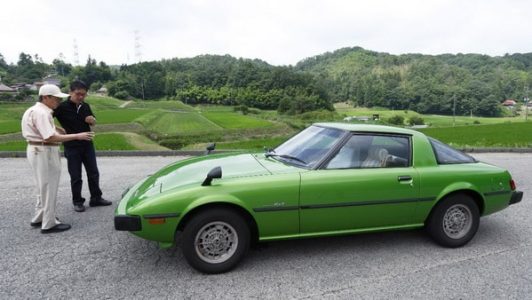
Mention the name “Maeda-san” in a Mazda design department, and you are sure to get a reverent response. The last two generations of this family have shaped the look of the Mazda brand more than most – but they don’t always see eye to eye when it comes to design. Here’s the story of an extraordinary design family.
Imagine a father and son, Matasaburo and Ikuo Maeda. Their relationship is complex, as father-son relationships often are. Full of mutual respect and love, yes, but also fraught with fundamentally diverging personalities and worldviews. The elder, an engineer by training, values austerity, simplicity and discipline.
His inspiration: the German Bauhaus movement, with its strong focus on function. The younger Maeda is a passionate racing car driver – friends and colleagues call him “Speedy” – and he loves objects that arouse emotions, that seem alive. His inspiration: the sensuality of Italian design, the dynamic energy of nature.
At first glance, the two men might seem almost like polar opposites. Yet they have something rather remarkable in common: Both are legendary car designers at Mazda, with some of the brand’s most influential models under their respective belts. A design dynasty that shapes Mazda’s aesthetic sensibilities to this day.
FORM FOLLOWS FUNCTION
Matasaburo Maeda, a native of Hiroshima, had witnessed first-hand the challenger spirit that arose out of the wreckage of his hometown – and the role Mazda played in this rebirth. He joined the company in 1962. Eighteen years later, Maeda had risen to the rank of General Manager of the Mazda Design Department, an office he held between 1980 and 1987. His tenure left a mark that still influences Mazda’s design philosophy today.
First, he was a firm believer in the principle “form follows function” – an adage that, despite all their differences, he passed on to his son Ikuo. For Maeda senior, design should never be frilly or ornamental. Every detail serves a purpose, nothing is superfluous. This approach found its expression in such models as the boxy Mazda 929 HB, sold from 1981 to 1986. The crowning achievement of the first Maeda design era, however, was the Mazda RX-7 – a classic rotary engine model still much loved by many Mazda fans.
According to Matasaburo Maeda, three principles dictated the characteristic clear lines and sleek elegance of this rotary engine car. “First, I was looking for the best way to express the character of the rotary engine. Second, it was about reducing drag, and third, I envisioned the RX-7 with a classic front-mid engine layout.” The different geometry of the rotary engine allowed the designers to bring down the vehicle’s nose much deeper than usual. Together with the pop-up headlights, this creates the sports car’s characteristic shape.
As the motor played such a big role in shaping the vehicle’s design, it is perhaps not surprising that Matasaburo decided to bring engineers and modellers into the fold early on in the design process. During his time at the helm of Mazda’s Design Department, Maeda developed a system of collaborative working between these three groups that is still the foundation of Mazda’s co-creation approach today.
LIKE FATHER, (UN)LIKE SON
That Ikuo Maeda would eventually follow in his father’s footsteps was by no means a foregone conclusion. Despite the enthusiasm with which Matasaburo tackled his task at Mazda, he left his work strictly at the office. “Even though the word ‘designer’ sounds attractive, the work itself is arduous and I never took it home with me,” remembers the elder Maeda.
In fact, the young Ikuo Maeda initially had no mind at all to pursue a career in car design, despite an early love for cars – especially racing cars. According to Ikuo, it was Steve McQueen’s 1971 epic Le Mans, not his father, that made him want to go into the automotive sector. “It was then that I decided I would like to get a job related to automobiles,” says Maeda.
A young Ikuo Maeda began studying industrial design at the Kyoto Institute of Technology, to all intents and purposes without breaking the Maeda rule of talking shop at the family home. When he turned up at his parents’ home in a white RX-7, he was completely unaware that his father had designed it. “I had bought this car simply because it was the fastest thing out there,” says Maeda, who, not coincidentally, has had his licence revoked for speeding twice. And, he admits, “I thought it looked pretty good, too.”
Nevertheless, in 1982, he began his career at the company that had made his father a living design legend. Fast forward a few decades, and the son, now Chief Designer of the Global Mazda Design Division, can claim the same honour for himself.
FROM STABILITY TO FLUIDITY
If you were to ask Ikuo Maeda to compare his father’s design philosophy to his own, the differences between them become quite clear. His father’s designs, the younger Maeda says, are “quiet and sleek”, his by contrast are “dynamic and full of movement”. Matasaburo, he adds, “pursues forms that are stable, whereas mine are all about instability and fluidity”.
Indeed, this emphasis on movement and changing forms is a central element of the design philosophy Ikuo Maeda established since taking the reins of Mazda Design in 2009. The “Kodo – Soul of Motion” design language aims to capture the beauty of movement in a still object. Many early designs in this new style were inspired by a cheetah about to pounce on its prey. A decade and many models later, the emphasis is still on condensing the powerful, raw energy of motion itself into an elegant and aesthetic form. This is what Ikuo Maeda means when he talks about his designs as being “emotional” – each Mazda car is supposed to move the spectator, to make him or her glean the energy distilled into this stationary object. A strategy that seems to be working, Matasaburo admits: “There is something about his design that just hits me. I get it. And it’s not because he’s my son.”
THE PAST, THE PRESENT, THE FUTURE
As the Kodo design concept evolved, the father’s influence on his son’s view of design started to become more pronounced. Like his father, Ikuo Maeda believes that less is more and that form should always follow function. Both Maedas clearly recall a defining moment in young Ikuo’s aesthetic education. While he was working on designs for the RX-7, Matasaburo Maeda gave his son a letter opener – a beautiful one, yet a very simple one. The glistening steel knife had been designed by Enzo Mari, a famous Italian designer and artist.
What made the design stand out was a twist that made it seem like a very strong man had taken the object and turned it by hand – a subtle yet very striking effect. “I wanted to convey to Ikuo how with one twist, a whole new expression could be achieved,” says Matasaburo. A lesson that his son certainly took to heart: “The encounter with this object represents a really important moment in my life. It is an object of essential form, really beautiful, but with a great deal of style content. It made me think – this is design. I was young, probably a junior high school student, and it made me start thinking that I would like to do this job,” Ikuo Maeda remembers. And he adds: “Maybe if I had never seen it, I would not be here today and I would not have chosen to become a designer.”
In fact, a certain admiration for the elegance of Italian design might just be one of the few things father and son agree upon. Legendary automotive designers Giorgietto Giugiaro and Nuccio Bertone have both been guests at the Maeda household.
Like Matasaburo Maeda, they were working on the outstanding designs of the Mazda Luce model series, particularly the iconic 1969 Mazda Luce Rotary Coupé. “I didn’t understand what they were saying, but what impressed me was the passion that they had and that they could communicate to everyone,” says the younger Maeda-san, and acknowledges their influence even on newer generations of Mazda cars.
What set Italian design apart, in Maeda’s eyes, was the attention on the frame as the centre around which design is built: “Designs with a focus on frames create strength and beauty,” Ikuo explains. “These people know the essence of a car.” When he got the chance to make an impact on the future look of Mazda cars, that was exactly what he set out to create.
Dynamic beauty, minimal design, a strong presence built around frames – all these became even more pronounced in the second phase of Kodo Design, starting with the concept car RX Vision in 2015. Mazda designers began stripping away any unnecessary elements, and even all character lines, from the vehicle body. The result: As light and shadow dance over the surface, shapes and movement are created that give the car the air of a living, breathing being with a soul – the soul of motion, to be exact.
THE MAEDA LEGACY
Ikuo Maeda indubitably instilled his own, unique character into the new Kodo design language: the emotional impact and dynamic strength that he sometimes missed in his father’s more “quiet and sleek” designs. Nevertheless, he never lost sight of his father’s legacy either. To many Mazda fans, the RX Vision is still the epitome of this twofold aesthetic path Ikuo Maeda carved out for himself.
With its emphasis on simplicity and elegance – not to mention the use of a rotary engine – the concept car is to some extent an homage to the Mazda design roots planted by Matasaburo Maeda years before. Every now and then, the current Mazda Design Director has even expressed a desire to revive the iconic Mazda RX 7. The very first car Ikuo Maeda worked on was the model’s immediate successor, the Mazda RX 8.
Does that mean that, after years of hashing it out, the two Maedas are today on the same page when it comes to design? Far from it. In fact, design is still somewhat of a taboo subject at family reunions. “We hardly speak about design because we respect each other so much. We know that if we start debating design, it will only end badly. So we deliberately avoid the topic,” explains Ikuo Maeda.
True to form, Matasaburo Maeda only learned about his son’s involvement in the Mazda RX 8 design about three months before the car went on sale in 2003. Reportedly, he deemed it “a fine job”. Mutual respect in spite of creative differences – that, too, is part of the Maeda design dynasty. Mazda would not be the same without it.


















No comment yet, add your voice below!